
FREE MAINLAND UK DELIVERY ON ALL ORDERS

Need Help? Call 0330 133 2247 - Mon-Fri 9AM-5PM

Belfast & Butler Kitchen Sinks

Butler and Belfast Kitchen Sinks

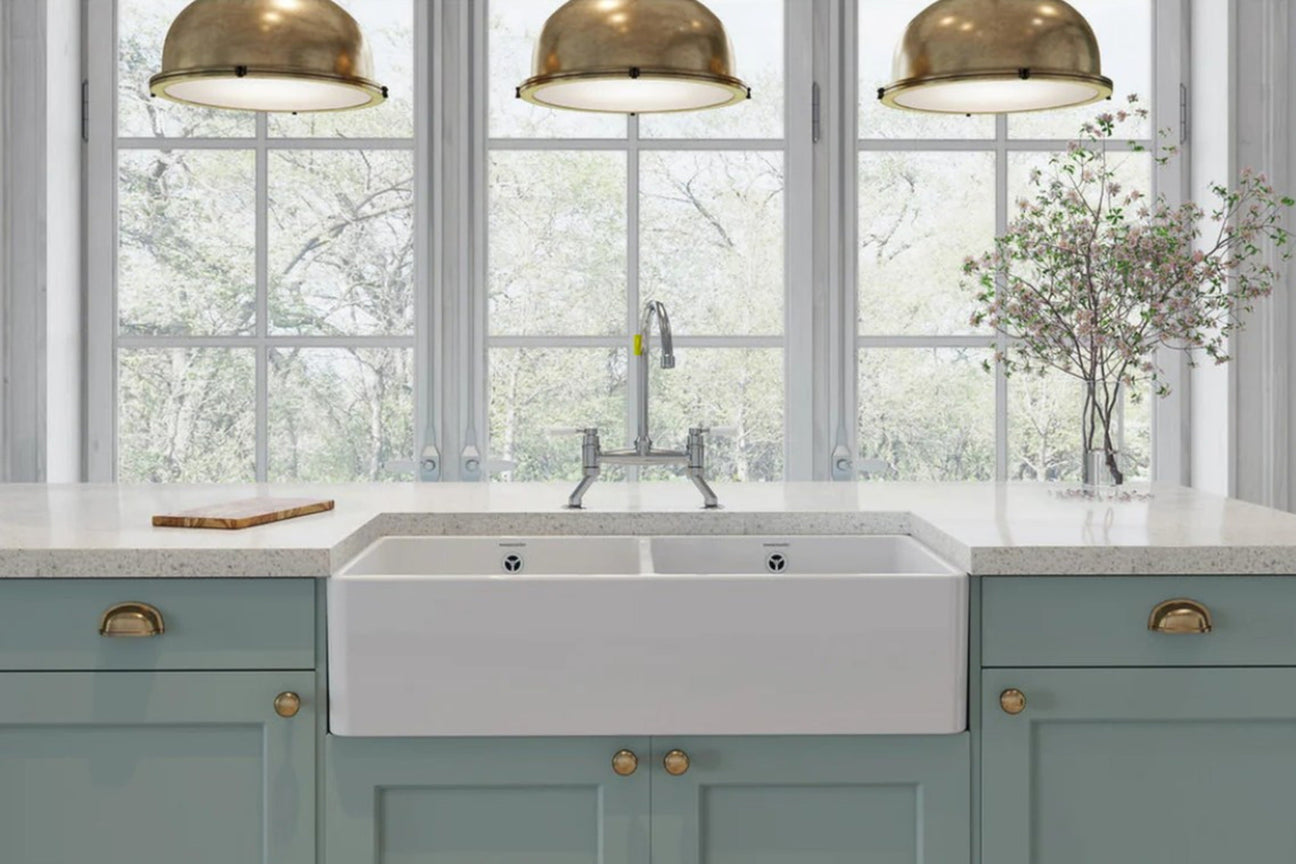
The front of the sink is part of the kitchen. That is what separates a Belfast sink from every other way of fitting one, and it is why people choose them long before they think about bowls or taps. It sits on its own base unit with that broad glazed face on show, and the cabinetry is built around it rather than over it.

Sitting on, not dropping in

Every sink here is a sit-on design. There is no rim resting on a worktop and nothing hanging beneath one, so the run of cabinetry has to be planned for the sink from the start. That is the honest constraint of the style and the reason it belongs in a kitchen project rather than a weekend swap. It is also why the look is so hard to imitate: the exposed face and the weight behind it read as permanent in a way a dropped-in bowl never quite does.

The weight is real. Fireclay is clay fired hard and glazed, and a full sink is a serious load for whatever carries it, so the base unit is built for the job rather than adapted to it. Any fitter who has worked with the style will plan for that.

Butler or Belfast

The two names come from a genuine old distinction. The Belfast sink was the deeper one, with an overflow, from a city where water was plentiful; the butler sink was shallower and had none, from a city where it was not. Today in Britain the words are used almost interchangeably, and you will find both across this range, sometimes on sinks that are near enough identical. Some carry an overflow and some do not, so the product page is the place to check rather than the name.

Fireclay, and the alternative

Nearly all of these are fireclay ceramic, which is what gives the deep white glaze, the crisp edges and the substantial feel. Fluted fronts turn up alongside plain ones for a more decorative period look. There is also a composite granite Belfast in the range, offering the same silhouette in a matte modern surface for anyone who wants the shape without the glaze.

One bowl or two, and where the water drains

The single bowl is the traditional shape and the more common here, one deep rectangle that takes a baking tray without argument. Double bowl versions are made in the same fireclay and the same silhouette, and they are worth knowing about, because plenty of people assume the farmhouse look only comes in one bowl. It does not.

Drainers are the other thing worth settling early. The classic shape is a plain rectangular bowl with nothing pressed or moulded beside it, so the drainer has to come from somewhere else: a separate ceramic draining board standing on the worktop, a set of grooves machined into the stone beside the sink, or simply a rack. Each of those suits the style better than a pressed steel drainer ever would, and the grooved worktop in particular is what most fitters will suggest.

Taps deserve a thought at the same time. Some of these sinks have a tap ledge and some expect the tap to go on the wall or the worktop behind, which shapes the whole arrangement.

If you like the material more than the mounting, the wider ceramic range includes inset and undermount ceramic sinks that fit into a conventional worktop instead.

For everything else the store carries, including the mounting styles this one deliberately avoids, start from the kitchen sinks range.

Why shop with The Tap Collection

Every order includes free mainland UK delivery and the full manufacturer warranty, and you can spread the cost with Klarna or PayPal Pay in 3 at checkout. Our UK based team is happy to help with sizing and compatibility questions: call 0330 133 2247, email info@thetapcollection.co.uk or send us a message through our contact form. We are open Monday to Friday, 9am to 5pm, and aim to reply within 24 hours on working days.

View as

Frequently Asked Questions

What is the difference between a Belfast sink and a butler sink?

Traditionally a Belfast sink was the deeper one with an overflow, and a butler sink the shallower one without. The distinction came from water supply, plentiful in Belfast and drawn from deep wells in London, so wasting a little down an overflow mattered in one city and not the other. Today the two names are used almost interchangeably.

Can you get a double Belfast sink?

You can, and there are several in this range. A double gives you two full bowls in the same fireclay and the same farmhouse silhouette, which suits anyone who wants to keep washing and rinsing apart without giving up the look. Single bowls remain the more traditional and the more common shape of the two.

Are Belfast sinks worth it?

If you want the look, nothing else comes close, and fireclay is a material that outlasts most kitchens fitted around it. If you mainly want a practical bowl, a conventional inset or undermount sink costs less and asks less of your cabinetry. The honest answer is that this is a choice about character first and practicality second.

What are the disadvantages of a Belfast sink?

Weight and commitment, mostly. Fireclay is heavy enough that the base unit has to be built to carry it, and the sink shapes the cabinetry rather than dropping into it, so it is a decision for the design stage. The exposed glazed front is also more visible than a rim, which is the point but does mean it shows.

Can you get a Belfast sink with a drainer?

Not as part of the sink itself. The classic shape is a plain rectangular bowl with no pressed or moulded drainer, which is why so many of these kitchens pair the sink with a separate ceramic draining board, a grooved section machined into the worktop, or a simple drying rack. All three suit the style better than an integrated drainer would.

Do you have to use a bridge tap or a wall-mounted tap?

Not necessarily, though those are the traditional pairings and they suit the look. Some of these sinks have a tap ledge and some do not, which is what decides the question. Where there is no ledge, the tap goes on the wall behind or on the worktop beside, and the product page will tell you which arrangement a sink expects.

What are these sinks made from?

Fireclay ceramic for nearly all of them, which is clay fired at very high temperature and finished with a hard glaze. That is what gives the deep white surface and the considerable weight. There is a composite granite option in the range too, for the same silhouette in a modern matte finish rather than a glaze.

Do you offer free delivery?

Yes, we offer free mainland UK delivery on all orders.

Orders are processed within 24 hours (Monday to Friday) and typically arrive within 1–4 business days. Please note that offshore regions and the Scottish Highlands may incur additional charges.

Do you offer finance or payment plans?

Yes, we do, we offer Klarna and PayPal Pay in 3 at checkout, allowing you to split your purchase into three interest-free payments with no fees, subject to approval.

Do you offer bulk or wholesale orders?

Yes, we can accommodate bulk and wholesale orders for selected products and projects.

If you’re purchasing multiple items for a trade, commercial, renovation or development project, please request a quote with the products and quantities you require.

Depending on the order size and brand, we may be able to offer tailored pricing, lead-time information and product recommendations.

Compare /3

Loading...