FREE MAINLAND UK DELIVERY ON ALL ORDERS

Need Help? Call 0330 133 2247 - Mon-Fri 9AM-5PM

Stylish Functional Kitchen Sinks collection thumbnail

The Kitchen Sinks Collection

Kitchen sinks do more work than almost anything else in the room. You wash, drain, fill and scrub in the same basin several times a day, so the right one comes down to how many bowls you need, how it sits against the worktop, and which material copes with the way you actually cook. Get those three right and the finish is the easy part.

How many bowls you need

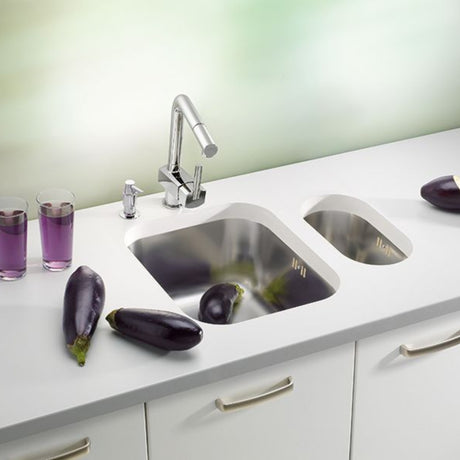
A single bowl is the simplest answer, and for most kitchens it's still the right one: one continuous space that takes a full baking tray or a stockpot without a divider in the way, which is why it's the most searched configuration of the four. A 1.5 bowl sink adds a smaller second basin alongside the main one, useful for draining vegetables or parking a dirty pan out of the way while the main bowl stays free for washing up, and it's the fastest-growing of the group, worth a look if you've ever wanted a bit more separation without losing the big single bowl underneath it. Double bowl splits the space more evenly again, which suits a household that genuinely treats washing and draining as two separate jobs rather than one, though it gives up the unbroken span the other two keep. A one-and-a-quarter bowl sits between single and 1.5, its small second bowl better suited to a drainer or a prep basin than a second full sink.

Compare single bowl, 1.5 bowl, double bowl and one-and-a-quarter bowl sinks side by side before deciding.

Inset, undermount or Belfast

Undermount is where most kitchens are heading. Fixed beneath the worktop rather than sitting on top of it, it leaves no rim between worktop and bowl, which is why it's grown faster than any other mount type recently and has become the default choice once you move up through the range. It does ask more of your worktop in return, since that seamless fit only works against a solid surface, not laminate. Inset sits proud of the worktop instead, held by its own rim, and that makes it the more forgiving fit: it works with any worktop material, laminate included, which is why it stays the easiest of the group to fit into a kitchen you're not rebuilding from scratch. Belfast and butler sinks are the traditional apron-front option, the bowl exposed at the front rather than tucked under a worktop lip, chosen for a farmhouse or period kitchen more than for the seamless line undermount offers. Flush mounted sinks split the difference, sitting level with the worktop rather than above or below it, worth a look if you want undermount's clean line without needing a solid worktop to get it.

See undermount, inset and Belfast and butler sinks to compare the fit against your own worktop.

Ceramic, steel or composite

Ceramic is the material most people picture when they hear "kitchen sink," and it's still the one most buyers search for by name, ahead of stainless steel. The classic white finish reads as a settled, permanent choice rather than a passing trend. Stainless steel is the closest rival by search volume, the practical pairing for a kitchen that already leans toward steel appliances. Granite and composite sinks are the newest arrivals of the three, and increasingly chosen in black and grey rather than white or steel, worth a look if you want the sink itself to make a statement rather than disappear into the worktop.

Browse ceramic, stainless steel and granite sinks to see the full range in each.

How much to spend

Spend more on a kitchen sink and the range changes in a fairly consistent sequence. At the entry level, steel and inset sinks cover the basics honestly, with nothing missing that a first kitchen actually needs. Move into the next tier and composite and granite sinks join the range alongside larger bowl configurations. Further up, undermount becomes the default mount rather than the exception, and the first workstation-style accessories, boards, colanders and grids built into the design, start to appear. At the top of the range, natural stone materials, bespoke finish colours beyond standard white or steel, and full workstation accessory sets are all on the table.

Why shop with The Tap Collection

Every order includes free mainland UK delivery and the full manufacturer warranty, and you can spread the cost with Klarna or PayPal Pay in 3 at checkout. Our UK based team is happy to help with sizing and compatibility questions: call 0330 133 2247, email info@thetapcollection.co.uk or send us a message through our contact form. We are open Monday to Friday, 9am to 5pm, and aim to reply within 24 hours on working days.

View as

Frequently Asked Questions

What's the difference between an inset and an undermount sink?

Inset sinks sit proud of the worktop, held by a visible rim, while undermount sinks fix underneath it so there's no rim between worktop and bowl. Inset works with any worktop material, which is what makes it the easier of the two to fit into an existing kitchen. Undermount needs a solid worktop to fix to, which is what gives it the seamless look but also what limits where it can go.

Is a 1.5 bowl sink better than a single bowl?

Neither wins outright; they suit different habits. A single bowl gives you one uninterrupted space that takes a full tray or stockpot without a divider in the way, which is why it stays the most searched configuration. A 1.5 bowl adds a smaller second basin for draining or parking a dirty pan, worth choosing if you'd rather keep those two jobs apart.

Can I get a kitchen sink in black or grey rather than white or steel?

Yes, though colour is a separate choice from material. It's mainly granite and composite sinks that come in black and grey, rather than the classic white of ceramic or the natural finish of stainless steel, so that's the pair to start from if colour matters more to you than the material itself. Ceramic and steel are far more likely to come in their traditional finish only.

Does an undermount sink need a solid worktop?

Yes. Undermount sinks fix to the underside of the worktop rather than resting on top of it, and that only works with a solid worktop, not laminate. That's also where the seamless look comes from, since the worktop edge runs straight into the bowl with no rim in between. If your worktop is laminate, an inset or flush mounted sink is the better fit.

What's the difference between a Belfast and a butler sink?

Less than the two separate names suggest. Both are traditional apron-front sinks, the bowl exposed at the front rather than tucked beneath the worktop, and in practice the terms describe closely related styles rather than two genuinely different products. Both sit closer to a farmhouse or period look than the seamless finish of an undermount sink.

Do all kitchen sinks come with a drainer?

No. Whether a sink includes a drainer is its own choice, separate from material or mount, and plenty are sold without one for a buyer who'd rather use a rack instead. Where a drainer is included, it's usually reversible, so it can sit on the left or the right depending on how your kitchen's laid out. Check the individual listing to be sure.

Do you offer free delivery?

Yes, we offer free mainland UK delivery on all orders.

Orders are processed within 24 hours (Monday to Friday) and typically arrive within 1–4 business days. Please note that offshore regions and the Scottish Highlands may incur additional charges.

Do you offer finance or payment plans?

Yes, we do, we offer Klarna and PayPal Pay in 3 at checkout, allowing you to split your purchase into three interest-free payments with no fees, subject to approval.

Do you offer bulk or wholesale orders?

Yes, we can accommodate bulk and wholesale orders for selected products and projects.

If you’re purchasing multiple items for a trade, commercial, renovation or development project, please request a quote with the products and quantities you require.

Depending on the order size and brand, we may be able to offer tailored pricing, lead-time information and product recommendations.

Compare /3

Loading...